
- … on torus actions and lower curvature bounds
- … on (moduli) spaces of Riemannian metrics
- … on equivariant bordism
- … on elliptic genera
- … on toric spaces
Research on torus actions and lower curvature bounds
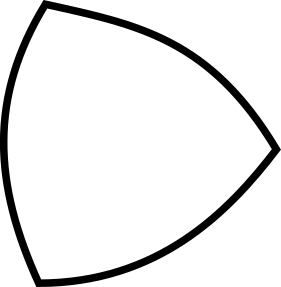
A long-standing open problem in Riemannian Geometry asks for the classification of all closed manifolds that admit a metric of positive sectional curvature. What makes this problem hard is that there are only a few examples of such manifolds known while on the other hand there are not many known obstructions for a manifold to admit such metrics. The Grove Symmetry Program asks to do this classification under the extra assumption of an isometric, effective action of a compact Lie group on the manifold. In the past few years the dimension of the Lie group which was necessary to do such a classification significantly decreased.
My recent contributions (with Lee Kennard and Burkhard Wilking) to this subject include a proof of the famous Hopf conjecture from the 1930s under mild symmetry assumptions (see 3.). Moreover, under slightly more restricted conditions we compute rational cohomology rings of positively curved manifolds with torus symmetry (see 1., 3.). In dimension ten Anusha Krishnan and I can compute the homotopy types of positively curved manifolds with actions of three-dimensional tori (see 2.).
In these studies we use Wilking’s connectedness lemma, Kennard’s four-periodicity theorem, matroid theory, and results from equivariant topology including the Chang Skjelbred lemma and localization theorems.
References
- L. Kennard, M. Wiemeler, B. Wilking, Positive curvature, torus symmetry, and matroids, J. Eur. Math. Soc. (JEMS) (2025), DOI:10.4171/JEMS/1656, arXiv:2212.08152
- A. M. Krishnan, M. Wiemeler, Positively curved -manifolds with -symmetry, Commun. Contemp. Math. 27 (2025), no. 10, Paper No. 2550018, DOI:10.1142/S021919972550018X, arXiv:2310.12689
- L. Kennard, M. Wiemeler, B. Wilking, Splitting of torus representations and applications in the Grove symmetry program, Preprint, arXiv:2106.14723, 2021
Research on (moduli) spaces of Riemannian metrics
When one knows that a manifold admits a Riemannian metric with some constraint on its curvature such as positive (sectional, Ricci or scalar) curvature, the next question is to ask „how many“ such metrics exist on the manifold. The correct mathematical formulation for this question is to ask what can be said about the topology of the space of metrics satisfying the constraint. Sometimes one is only interested in the isometry classes of Riemannian manifolds diffeomorphic to a given smooth manifold . In that case one has to study so-called moduli spaces of metrics on .
A recent contribution to this subject (with Johannes Ebert) is a proof that the homotopy type of the space of positive scalar curvature metrics on high dimensional simply connected spin manifolds only depends on the answer of the question whether there is a positive scalar curvature metric on or not (see 1.). Another contribution with Wilderich Tuschmann is the proof that in many cases moduli spaces of non-negatively Ricci curved metrics have non-trivial homotopy groups (see 2.). In 3. I showed that the fundamental group of a variant of the moduli space of positive scalar curvature metrics which takes orientations of the manifold into account is non-trivial for closed -connected -manifolds with .
In 1. we use the invariance of the homotopy type of the space of positive scalar curvature metrics under certain surgeries originally proved by Chernysh and later refined by Kordaß. Moreover, we use the characterization of those bordism classes of spin manifolds which can be represented by such manifolds with positive scalar curvature metrics and bordism computations.
The main tool in 2. is the Cheeger-Gromoll splitting theorem for manifolds with non-negative Ricci curvature. The proof in 3. is based on Ebin’s slice theorem and elementary geometric arguments.
References
- J. Ebert, M. Wiemeler, On the homotopy type of the space of metrics of positive scalar curvature, J. Eur. Math. Soc. (JEMS) 26 (2024), no. 9, 3327-3363, DOI:10.4171/JEMS/1333, arXiv:2012.00432
- W. Tuschmann, M. Wiemeler, On the topology of moduli spaces of non-negatively curved Riemannian metrics, Math. Ann. 384 (2022) No. 3-4, 1629-1651, DOI:10.1007/s00208-021-02327-y, arXiv:1712.07052
- M. Wiemeler, On moduli spaces of positive scalar curvature metrics on highly connected manifolds, Int. Math. Res. Not. IMRN 2021 (2021) No. 11, 8698-8714, DOI:10.1093/imrn/rnz386, arXiv:1610.09658
Research on equivariant bordism
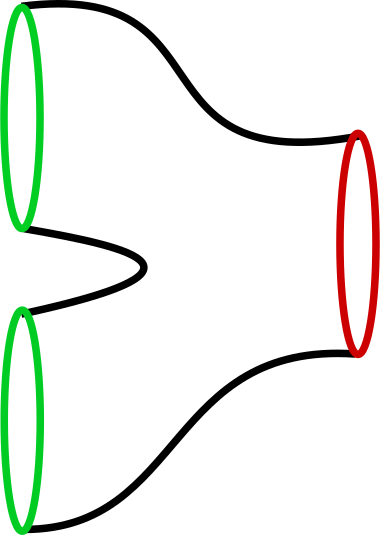
One says that two closed manifolds are bordant if there is a manifold with boundary whose boundary is diffeomorphic to the disjoint union of the two closed manifolds. The set of the equivalence classes of all manifolds is a graded ring, the so-called (unoriented) bordism ring. One can also define bordism rings of manifolds with extra structure on the stable tangent bundle. As proved by Thom in the 1950s these rings are isomorphic to stable homotopy groups of so-called Thom spectra.
When one considers manifolds with action of a compact Lie group , it is natural to also introduce a bordism relation for those. A similar definition as in the first sentence from the previous paragraph then leads to what is called geometric -equivariant bordism. This sort of bordism has been pioneered by Conner and Floyd. However one can also generalize the Thom spectra to -equivariant Thom-spectra, as was done by tom Dieck. This construction leads to homotopy-theoretic -equivariant bordism. The main difference to the non-equivariant situation is that in the -equivariant world geometric and homotopy-theoretic bordism are non-isomorphic.
With Bernhard Hanke I have proved a result concerning the algebraic structure of homotopy-theoretic -equivariant unitary bordism (see 2.). Our main result says that this ring is isomorphic to the -equivariant Lazard ring which classifies -equivariant formal group laws. Thereby we proved the first case of a conjecture made about 20 years earlier by Cole Greenlees and Kriz.
I also worked on constructing generators of certain geometric -equivariant bordism rings (see 1., 3.). These results were used to construct invariant metrics of positive scalar curvature on -manifolds and to give a new proof for the rigidity of elliptic genera for spin manifolds admitting a non-trivial -action.
References
- M. Wiemeler, -equivariant bordism, invariant metrics of positive scalar curvature, and rigidity of elliptic genera, J. Topol. Anal. 12 (2020) No. 4, 1103-1156, DOI:10.1142/S1793525319500766, arXiv:1506.04073
- B. Hanke, M. Wiemeler, An equivariant Quillen theorem, Adv. Math. 340 (2018), 48-75, DOI:10.1016/j.aim.2018.10.009, arXiv:1711.02399
- M. Wiemeler, Circle actions and scalar curvature, Trans. Amer. Math. Soc. 368 (2016), No. 4, 2939-2966, DOI:10.1090/tran/6666, arXiv:1305.2288
Research on elliptic genera
A genus is a ring homomorphism from the oriented bordism ring to a -algebra. The elliptic genus is a certain genus that takes values in power series with coefficients in . It is related to modular forms. The elliptic genus can be refined to the -equivariant elliptic genus which is a homomorphism from the geometric -equivariant oriented bordism ring to the ring of power series in one variable with coefficients in the ring of Laurent polynomials with rational coefficients in one variable. As shown by Bott and Taubes this equivariant genus is rigid for closed spin manifolds with -action, i.e. all the Laurent polynomials which appear as coefficients in the equivariant elliptic genus of such a manifold are constants.
Recently I extended this rigidity result to closed nonspin manifolds whose universal covering is spin (see 2.). Moreover I showed that for closed manifolds whose universal covering is nonspin there is no condition which implies the rigidity of the elliptic genus which only depends on the first two homotopy groups of the manifolds. This showed that there was a mistake in a paper which claimed this.
Witten gave a heuristic argument that the elliptic genus as above should be seen as „the signature“ of the free loop space of a closed manifold. He also introduced a genus, the so-called Witten genus, which should be interpreted as „the -genus“ of the free loop space of a closed manifold. Later Stolz gave a heuristic argument for the following claim: If a closed manifold has positive Ricci curvature then its free loop space should have „positive scalar curvature“. Consequently he conjectured that the Witten genus of a string manifold with positive Ricci curvature must vanish.
In 1. I give new evidence for this conjecture. The new examples are string complete intersections in Fano manifolds with second Betti number one and a smooth effective action of a two-dimensional torus. These complete intersections have both metrics of positive Ricci curvature and vanishing Witten genus.
In 3. I show that all toric string Fano manifolds are biholomorphic to products of copies of . Since bounds an orientable manifolds this shows the Stolz conjecture for these manifolds. The proof is based on an application of the Mukai conjecture which is known to be true in the toric case.
References
- M. Wiemeler, Witten genera of complete intersections, Bull. Lond. Math. Soc. 58 (2026), no. 2, Paper No. e70295, DOI:10.1112/blms.70295, arXiv:2410.21412
- M. Wiemeler, Rigidity of elliptic genera for nonspin manifolds, Algebr. Geom. Topol. 25 (2025), no. 4, 2083-2097, DOI:10.2140/agt.2025.25.2083, arXiv:2212.01059
- M. Wiemeler, On a conjecture of Stolz in the toric case, Proc. Amer. Math. Soc. 152 (2024), no. 8, 3617-3621, DOI:10.1090/proc/16823, arXiv:2310.08456
Research on toric spaces
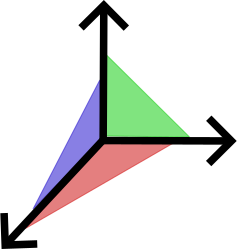
Torus manifolds are far reaching topological generalizations of smooth toric varieties. They are studied in Toric Topology. A torus manifold is a -dimensional orientable manifold with an effective action of an -dimensional torus such that the fixed point set is non-empty.
In 1. I classified locally standard torus manifolds and other manifolds with torus action up to equivariant diffeomorphism in terms of their orbit spaces and the appearing isotropy groups. While such a classification was stated at several places in the literature, so far there was no proof which only uses elementary methods.
In 3. I gave a classification of those simply connected torus manifolds which admit invariant metrics of non-negative sectional curvature up to equivariant diffeomorphism. 3. also contains a classification of simply connected rationally elliptic torus manifolds with vanishing odd degree integral cohomology up to non-equivariant homeomorphism. The main new ingredient in the proof is a classification of convex polytopes whose two-dimensional faces have at most four vertices.
The special case of rationally elliptic toric varieties has been studied in 2. For those of them which only have orbifold singularities I can give a classification up to algebraic isomorphism. Here both the assumption and conclusion are stronger than in 3.
References
- M. Wiemeler, Smooth classification of locally standard -manifolds, Osaka J. Math. 59 (2022) No. 3, 549-557, https://projecteuclid.org, arXiv:2011.10460
- M. Wiemeler, Classification of rationally elliptic toric orbifolds, Arch. Math. 114 (2020), 641-647, DOI:10.1007/s00013-019-01430-6, arXiv:1906.01335
- M. Wiemeler, Torus manifolds and non-negative curvature, J. Lond. Math. Soc., II. Ser. 91 (2015), No. 3, 667-692, DOI:10.1112/jlms/jdv008, arXiv:1401.0403